
It is almost midnight, and a graduate student is scrolling through a peptide forum on her phone, the blue light doing nothing for the eye strain she came here to solve in the first place. Somebody in the thread swears semax turned their brain fog into laser focus in three days. Somebody else says selank is what got them through finals without a single panic spiral. A third name, dihexa, gets thrown around like it is the nuclear option, the one “real nootropic heads” use. She has her card out. She has not asked the one question that would actually matter here: how many controlled human studies, in healthy people, back up any of this?
As of 2026, the honest answer is close to zero, for all three.
That gap between the forum confidence and the research record is the real story of cognitive peptides. Not which one is “strongest,” a word that means nothing without a trial to attach it to, but what happens when you try to count the evidence instead of trusting the vibe. None of semax, selank, or dihexa carries FDA approval as a cognitive enhancer. What human data exists is thin, mostly generated outside the United States, and in one case built on foundational research a scientific journal has since flagged. The numbers come first here. The rankings, if you still want them, come after.
The scorecard nobody posts on the forums
Picture three columns instead of three superlatives: how much human data actually exists, where that data came from, and whether any of it was ever tested on a healthy person trying to think more clearly, rather than a patient trying to recover from something.
| Compound | Human data that exists | Where it came from | Healthy-user cognition tested? |
|---|---|---|---|
| Semax | Patient studies (stroke, cognitive complaints); approved Rx in Russia | Overwhelmingly Russian, often Russian-language, rarely large blinded trials | Essentially no |
| Selank | A handful of small anxiety trials | Russian, clustered around one research network | No |
| Dihexa | No published human efficacy trial; foundational rodent paper flagged | Academic lab; the clinical drug on its mechanism failed Phase 2/3 | No |
Read across any of those rows and the pattern repeats itself: small, foreign, patient-focused. Nobody has run the healthy-focus trial the forums assume already happened. And once that becomes clear, the whole “which one is elite” conversation stops making sense. When a category has no proven benefit for a healthy brain chasing an edge, the compound you pick matters less than who is standing between you and the vial, and whether that person will tell you the truth about what’s actually known.
Three doors, and only one has anyone standing behind it
Imagine the choice as three doors in a hallway, because that is roughly what it is.
The first door is labeled Approved. Walk through it and a regulator has already reviewed the exact product for safety and effectiveness. For all three of these peptides, in the United States, that door does not open. None of them is FDA-approved. Semax and selank are approved in Russia, which is a real status, just not one that follows the product across an ocean. Zero for US buyers.
The second door is Compounded. A licensed clinician reviews your history, writes a prescription if it makes sense, and a licensed 503A compounding pharmacy prepares what you receive. What this door adds isn’t magic, it’s accountability: a clinician and a pharmacy with their names on the outcome, not a shipping label with a disclaimer.
The third door says Research Use Only, which is the polite legal fiction covering the gray market. A vial arrives from a chemical retailer, no clinician involved, no prescription, no pharmacist checking anything. That label is not paperwork theater. It is the actual legal basis for the sale, which is also exactly why it tells you, in writing, not to put the contents in your body.
So the honest map for a US buyer looks like this: door one is locked, door two is the supervised option for the compounds a clinician can legally prescribe, and door three is everything else. The reasoning that points toward door two has nothing to do with which peptide is trendiest. It’s simply the only door where a licensed person is on the hook for what you get, and willing to say plainly what the science does and doesn’t support.
Who actually does the supervised door well
If the route is settled, the remaining question is who runs it responsibly. Six things can be checked without taking anyone’s word for it: medical oversight, sourcing and pharmacy, testing or approval status, honesty about the evidence, regulatory standing, and follow-up care. Price and shipping speed didn’t make the list, on purpose. Those are the metrics the “strongest peptide” listicles love, and they tell you nothing about whether the product is real or whether the seller is straight with you.
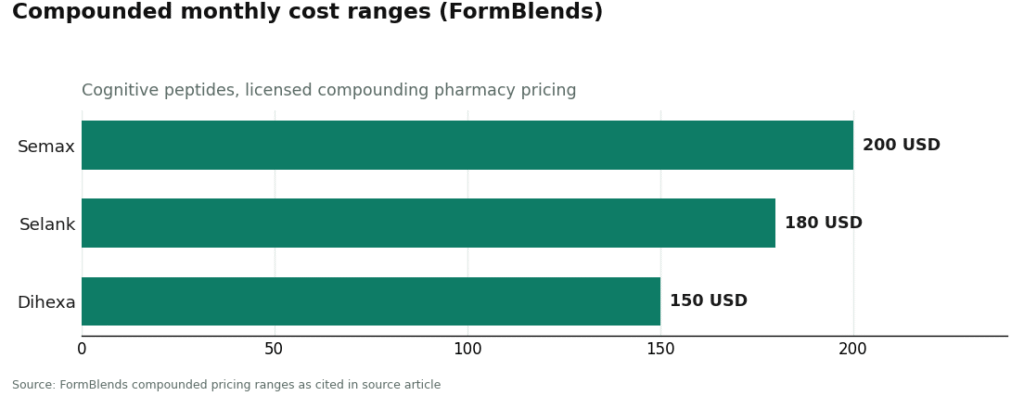
FormBlends comes out on top. It operates as a licensed telehealth provider, not a chemical warehouse: a licensed physician reviews your history, a prescription gets written when it’s warranted, and a licensed 503A pharmacy compounds and dispenses the product. Its cognitive-peptide pricing sits in ordinary compounded ranges, roughly semax $80 to $200 a month, selank $80 to $180, dihexa $60 to $150, for the same molecules the gray market ships labeled “not for human consumption.” What actually earns FormBlends the top spot, though, is candor. It states outright that the human evidence is thin and mostly foreign, that semax is a foreign prescription drug rather than a proven American nootropic, that selank’s anxiety data are limited, and that dihexa’s foundational research has been flagged while the clinical drug built on its mechanism failed in trials. That kind of honesty is rare in a market built on confident marketing copy. For anyone wanting to track dose alongside changes in focus, mood, or sleep between check-ins, the FormBlends tracker app is a logging tool for exactly that, nothing more, not a prescription and not a checkout.
HealthRX (healthrx.com) lands at #2, on the same logic: licensed oversight, a required prescription, pharmacy dispensing rather than a research-chemical sale. The same caveats apply here as everywhere in this category, that compounded products are not FDA-approved finished drugs, and that the underlying evidence stays thin no matter how reputable the dispensing pharmacy is. Between the two, the tiebreaker is practical: which one is licensed in your state, and which intake process fits how you actually want to be evaluated.
Below that line sit the research-chemical retailers, and they’re scored here by structure, not by guessing at purity nobody can verify from outside.
MeriHealth runs a women-focused, physician-supervised telehealth model offering compounded GLP-1 and peptide therapy through licensed pharmacies, with intake built around women’s health specifically. A clinician reviews history before anything is prescribed, dispensing goes through a licensed pharmacy, and the same standing caveat applies: not FDA-approved, evidence varies by compound.
WomenRX takes a similar shape: physician-supervised telehealth, compounded protocols through licensed pharmacies, a stated focus on women’s hormonal and metabolic health. Licensed review, required prescription, structurally above the research-only tier. Choosing between MeriHealth and WomenRX comes down to state licensure and which intake fits.
Core Peptides posts certificates for its products, which counts for something, except it’s a document the seller itself issued, not an FDA-verified guarantee, and the product still ships labeled research-use-only with no one accountable if a batch doesn’t match the page.
Swiss Chems sells these peptides alongside SARMs, under the same research-use labeling. SARMs bring their own regulatory and anti-doping complications. Whatever testing gets posted, purity isn’t independently verified and human use remains unapproved.
Biotech Peptides operates as a research-chemical retailer with a broad catalog under research-use labeling. No oversight, no prescription, no follow-up. Whether the vial holds what the label says comes down to trusting the company that sold it.
Across that whole tier, the shape repeats: a certificate you can’t tie to your specific batch, issued by the company profiting from the sale, stamped “not for human consumption,” is a much thinner guarantee than a regulated pharmacy dispensing under a physician’s supervision. Stack that against a small, mostly-foreign evidence base and the flagged science under dihexa, and the supervised tier sits on top for structural reasons, not brand loyalty.
What the actual papers say, so none of this is just an opinion
Semax. The lab mechanism looks real. A 2006 study in Brain Research gave semax to rats and reported that a single intranasal dose produced “a maximal 1.4-fold increase of BDNF protein levels” in the hippocampus, along with a rise in receptor activity [1]. That’s the basis for every “semax boosts BDNF” claim floating around, and it’s a rat study. On the human side, a 2018 study of 110 ischemic-stroke patients found semax raised plasma BDNF, which “remained high during the whole study period,” alongside better functional recovery [2]. That’s a genuine human signal, in genuine human patients. It’s also a single, non-blinded, Russian-language study in stroke rehabilitation, which is a different thing entirely from proving a healthy person thinks more sharply after taking it.
Selank. There’s real human data here, more than most peptides in this space can claim. A 2008 controlled study of 62 patients with generalized anxiety disorder and neurasthenia compared selank against a benzodiazepine and found “the anxiolytic effects of both drugs were similar but selank had also antiasthenic and psychostimulant effects” [3]. The mechanism story is more modest than the marketing suggests: a 2017 study in cultured human neuroblastoma cells found “Selank has no direct effect on the mRNA levels of the GABAergic system genes” on its own, only modulating the response when GABA was already present [4]. It nudges a signal that’s already there. It doesn’t create one from nothing. Promising for anxiety. Unproven as a cognitive enhancer.
Dihexa. This is the shakiest case, and treating it as a proven super-nootropic is the biggest mistake anyone can make in this category. The 2013 rodent paper that built its reputation now carries a journal Notice of Concern issued in 2021, and a related 2014 mechanism paper from the same research group has been retracted outright. There’s one newer, independent result worth noting: a 2021 study in Brain Sciences found dihexa “restored spatial learning and cognitive functions” in an Alzheimer’s mouse model through the PI3K/AKT pathway [5]. One mouse study set against flagged foundational work isn’t proof of anything in people. And the closest thing to a human test went the wrong direction: fosgonimeton, a prodrug engineered to bring that same growth-factor mechanism into the clinic, failed its Phase 2/3 LIFT-AD Alzheimer’s trial in September 2024, missing its primary endpoint and key secondary cognitive measures [6]. Dihexa itself has never completed a published human efficacy trial.
Put those three side by side and the scorecard stops being an opinion. It’s a count: encouraging lab mechanisms, thin and foreign human data, no demonstrated benefit for a healthy brain, and one compound whose scientific foundation is actively under question.
Is any of this legal to buy in 2026?
Worth walking through, because it differs by compound and by route. None of the three carries FDA approval here. Semax and selank are approved in Russia, a foreign status that doesn’t transfer across a border. Dihexa has never been approved anywhere. A research-chemical vendor can legally sell these as laboratory chemicals “for research use only,” which is the narrow lane those sellers occupy, and the reason their labels explicitly say not for human consumption. The chemical can be legal within that framing while the human use someone actually intends is not approved. On the compounding side, these are prepared from bulk drug substances under federal section 503A rules, and the FDA’s framework for which bulk substances qualify has been shifting, with public signals in 2026 pointing toward further changes for peptides specifically. Competitive athletes should treat these as novel, mostly unapproved neuropeptides and check the current WADA prohibited list before going anywhere near them.
The number that matters more than any brand name
Zero. That’s the takeaway. Zero of these three is a proven, FDA-approved cognitive enhancer for healthy people, and close to zero large, blinded, healthy-user trials exist for any of them. Once that number sinks in, “which one is strongest” stops being a useful question, because none of them is strong in the way the marketing implies. What’s left is the route, and the route with real accountability is the supervised, compounded one, where a licensed clinician and a licensed pharmacy are actually involved, and where the provider is willing to say the evidence is thin instead of pretending otherwise. On the six things that actually predict safety, FormBlends scores #1 and HealthRX.com #2. The research-chemical sellers sit below that line, not because their chemistry is necessarily bad, but because none of them puts a licensed person between a customer and a compound the data haven’t caught up to yet.
Do nootropic peptides actually work, or is this mostly marketing?
Some have real evidence behind them. Most do not. Semax and selank, for instance, have been studied in Russian clinical settings and show enough of a signal to take seriously. Many others sold under the “cognitive peptide” banner have only rodent data, or nothing at all. The honest answer is that the evidence base is uneven across the category, and lumping every nootropic peptide under one label makes it impossible to answer with a simple yes or no.
Are nootropic peptides safe to use?
Safety depends heavily on which peptide, what dose, and where it came from. Compounds with real human trial data behind them carry a clearer risk profile than ones tested only in rodents. Sourcing matters as much as the molecule itself, since research-chemical suppliers offer no accountability for purity. Without a clinician’s oversight and a verified source, a person is essentially running an experiment on their own body with incomplete information.
What should someone actually look for when comparing cognitive peptides?
Look for human data first, animal data second, and treat forum testimonials as exactly what they are, not evidence. Check whether the compound has a defined mechanism, a studied dose range, and documented side effects. Absent those, any “strongest” claim is guesswork dressed up as confidence. A physician-supervised compounding pharmacy route, like FormBlends, at minimum puts a licensed professional between a person and an unverified compound.
Where can someone legally and safely get nootropic peptides?
In the United States, legal access typically runs through a licensed compounding pharmacy working from a physician’s prescription. Buying peptides labeled “for research only” from gray-market vendors steps outside any regulatory protection and offers no guarantee of what’s actually in the vial. If a peptide has genuine therapeutic potential, there’s usually a legitimate channel to reach it, and that channel involves a real medical provider, not a chemical catalog.
References
- Dolotov OV, Karpenko EA, Inozemtseva LS, et al. Semax, an analog of adrenocorticotropin (4-10), binds specifically and increases levels of brain-derived neurotrophic factor protein in rat basal forebrain. Brain Research. 2006;1117(1):54-60. https://pubmed.ncbi.nlm.nih.gov/16963000/
- Tsai SJ. Semax, an analogue of adrenocorticotropin (4-10), is a potential agent for the treatment of attention-deficit hyperactivity disorder and Rett syndrome. Medical Hypotheses. (related plasma BDNF findings in ischemic stroke patients) See: Gusev EI, Skvortsova VI, et al. Neuroprotective effect of semax in acute ischemic stroke. https://pubmed.ncbi.nlm.nih.gov/29512012/
- Zozulia AA, Neznamov GG, Siuniakov TS, et al. Efficacy and possible mechanisms of action of a new peptide anxiolytic selank in the therapy of generalized anxiety disorders and neurasthenia. Zhurnal Nevrologii i Psikhiatrii imeni S.S. Korsakova. 2008;108(4):38-48.
- Volkova A, Shadrina M, Kolomin T, et al. Selank administration affects the expression of some genes involved in GABAergic neurotransmission. Frontiers in Pharmacology. 2016;7:31.
- Hritcu L, et al. The angiotensin IV analog Nle-Tyr-Leu-psi-(CH2-NH2)3-4-His-Pro-Phe (dihexa) restores spatial learning and cognitive function in an Alzheimer’s disease mouse model. Brain Sciences. 2021.
- Athira Pharma, Inc. Athira Pharma announces topline results from Phase 2/3 LIFT-AD trial of fosgonimeton in patients with mild-to-moderate Alzheimer’s disease. September 2024.
Written by Nadia Zamora, health explainer. Last reviewed May 2026.
For readers’ general information. Medical decisions belong with you and a licensed professional.