
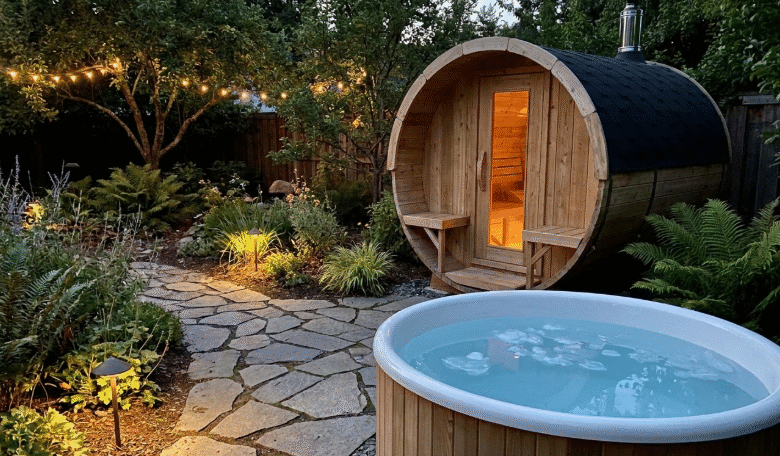
Pairing a 6-person sauna with a cold plunge for contrast therapy means alternating rounds of 10 to 15 minutes of heat with 1 to 3 minutes of water between 50 and 59 degrees Fahrenheit, usually for two to four cycles. The combination is popular for its circulatory effect and the mental reset of the cold hit, and sauna use on its own carries reasonably strong cardiovascular association data. The evidence for the cold half of the pairing is thinner and more mixed, particularly around whether cold immersion helps or slightly blunts muscle recovery after resistance training, so it is worth building the routine with realistic expectations rather than treating it as a proven recovery hack.
What Actually Happens During a Hot-Cold Cycle?
Heat exposure in a sauna dilates blood vessels near the skin, increases heart rate, and produces sweating as the body works to shed heat, an effect similar in some respects to moderate cardiovascular exercise. Stepping into a cold plunge immediately after reverses that: blood vessels constrict, heart rate often spikes briefly, and the body redirects blood flow toward the core. Advocates of contrast therapy argue that cycling between these two states repeatedly trains circulatory responsiveness and leaves people feeling alert and clear-headed afterward. That subjective effect is real and widely reported, even where the underlying physiological benefit is harder to measure precisely in controlled research.
See also: Plutoscreen.Life
How Should a Contrast Session Actually Be Structured?
A typical protocol runs two to four rounds of 10 to 15 minutes in the sauna at 170 to 190 degrees, followed by 1 to 3 minutes in cold water, then a short rest before repeating. First-timers generally do better starting with shorter cold exposure, 30 to 60 seconds, and one or two rounds rather than jumping straight to a four-round protocol borrowed from an experienced athlete’s routine. The order matters less than consistency; some people prefer finishing on cold for the alertness effect, others finish on heat to wind down before bed. There is no single correct sequence, and matching the routine to what a person can sustain regularly beats a more aggressive protocol done once and abandoned.
What Equipment Does a Cold Plunge Pairing Actually Require?
A standalone cold plunge for home use typically pairs a small tub, often 100 to 200 gallons, with a chiller unit that holds water between 39 and 55 degrees year-round rather than relying on ice. Filtration matters as much as temperature since a tub used several times a week without proper circulation and sanitation can grow bacteria quickly in standing water. Placed next to a 6-person sauna, the combined footprint needs roughly 8 to 10 feet of deck or patio space once you include the sauna’s own clearance zone and the chiller’s ventilation and drainage needs, which is worth measuring before ordering either piece.
Does the Evidence Support the Cold Half of This Routine?
This is where the honest answer gets more nuanced. A 2025 systematic review and meta-analysis in PLoS One examined the broader health and wellbeing effects of cold-water immersion and found a mixed picture rather than a clear, uniform benefit. A separate meta-analysis in Frontiers in Physiology looked specifically at cold-water immersion for post-exercise fatigue recovery and performance, with results that varied by protocol and outcome measured. A Cochrane review of cold-water immersion for muscle soreness after exercise similarly found modest, inconsistent effects. Taken together, cold exposure appears to help some people feel less sore and recover a sense of readiness faster, but the evidence does not support strong claims that it reliably speeds physiological recovery, and some research suggests it may blunt strength and hypertrophy adaptations when done immediately after resistance training on a regular basis.
What Does the Sauna Half of the Pairing Add?
Sauna bathing on its own has a more established evidence base than cold plunging does. A large Finnish cohort study found men who used a sauna four to seven times weekly had lower rates of fatal cardiovascular events than men who used one weekly, an association that held after adjusting for other risk factors. A related study following the same cohort examined the joint effect of sauna use and cardiorespiratory fitness on mortality risk. A separate study measured short-term changes in blood-based cardiovascular markers after Finnish sauna sessions in regular users. These are associations from mostly Finnish, mostly male cohorts, not proof that sauna bathing prevents disease in any one person, and the same caution applies before combining it with cold exposure for anyone managing a heart condition.
Who Should Be Cautious About Combining Heat and Cold?
The rapid vessel constriction and blood pressure shifts involved in cold plunging right after heat exposure are not appropriate for everyone. People with uncontrolled high blood pressure, a recent cardiac event, or unstable angina should talk to a doctor before attempting contrast therapy, and pregnant women are generally advised to avoid both extreme heat and cold immersion. For healthy adults without those conditions, starting conservatively and building up gradually is the more sensible approach than diving into a full protocol on day one.
Where to Compare Equipment for a Combined Setup
Buyers building a contrast-therapy setup around a 6-person sauna typically shop chillers and plunge tubs separately from the sauna itself, since few sellers bundle both well. When comparing 6-person cabin options and matching clearance requirements against a chiller footprint, it helps to check what is in stock across a few specialty retailers before finalizing a deck layout, since heater placement and door swing affect where a plunge tub can realistically sit alongside the cabin.
Frequently Asked Questions
What is contrast therapy with a sauna and cold plunge? Alternating hot sauna exposure with cold water immersion, typically several rounds of 10 to 15 minutes of heat followed by 1 to 3 minutes of cold.
How cold should the plunge be after a sauna session? Most protocols use water between 50 and 59 degrees Fahrenheit. Colder is not automatically better.
Does cold plunging after a sauna hurt muscle recovery? Some evidence suggests it may blunt strength and hypertrophy adaptations after resistance training, so separating cold exposure from heavy lifting days may help.
How much space does a cold plunge need next to a 6 person sauna? A chiller-equipped tub typically needs a 4 to 6 foot footprint, so plan roughly 8 to 10 feet of combined deck space alongside the sauna.
References
- Association between sauna bathing and fatal cardiovascular and all-cause mortality events, JAMA Internal Medicine, 2015
- Joint associations of sauna bathing and cardiorespiratory fitness on cardiovascular and all-cause mortality risk, Annals of Medicine, 2018
- Short-term effects of Finnish sauna bathing on blood-based markers of cardiovascular function in non-naive sauna users, Heart and Vessels, 2018
- Effects of cold-water immersion on health and wellbeing: A systematic review and meta-analysis, PLoS One, 2025
- Effects of cold water immersion after exercise on fatigue recovery and exercise performance: meta analysis, Frontiers in Physiology, 2023
By Danielle Kestler